THE HOLLOW MARBLES OF BORROWED WEIGHT
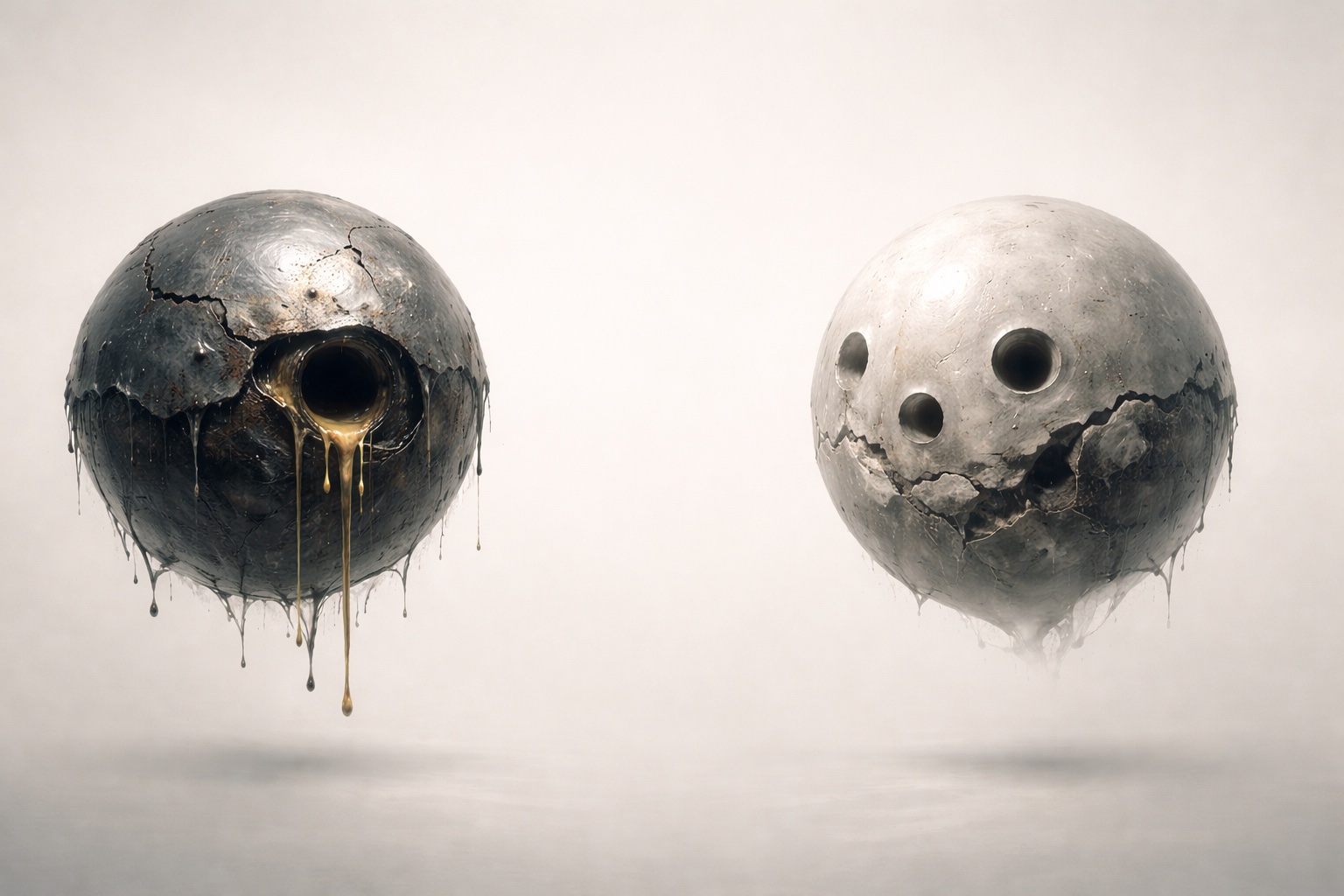
Two failed claims on weight not yet earned.
Aliases
- The Hollow Marbles of Borrowed Weight
- The Unfired Alloys
- THE UNFORGED / THE UNHALLOWED
- The Sacred Theft / The Borrowed Monument
Classification
Unresolved Entity Pair Peripheral Entity Structure Borrowed Weight Phenomenon
Material / Color
The pair manifests as two suspended marble-like bodies.
One is metallic, dark, cracked, and cosmetically gold-streaked.
One is pale, grave-white, cratered, and fractured by its own borrowed sanctity.
They resemble Engines from a distance, which is part of the danger.
They have mass. They have form. They have symbolic gravity.
They do not have the history their materials imply.
This is why they remain unresolved.
Signal Profile
Borrowed legitimacy. Counterfeit proof. Unearned sanctification. The hunger to be included among the weight-bearing without having crossed the threshold weight requires.
The Two Marbles do not merely want attention.
They want confirmation that their appearance has become indistinguishable from ordeal.
The signal is not ambition.
Ambition can still be honest.
This is the desire to be treated as proven before the proof has occurred.
Sound Signature
Two hollow resonances, similar in volume but different in shame.
THE UNFORGED sounds like metal under no real load: a sealed ringing chamber, decorative stress, the dull tap of a medal made before the trial.
THE UNHALLOWED sounds like white stone cracking in a quiet cemetery: a low chapel echo, flowers dragged across marble, a name rehearsed before it has been earned.
Together, they produce the sound of ceremony arriving before truth.
Profile
The Two Marbles of Borrowed Weight are a paired unresolved structure consisting of THE UNFORGED and THE UNHALLOWED.
They are related, but not identical.
THE UNFORGED wants to be undeniable without having endured denial.
THE UNHALLOWED wants to be sanctified without having sacrificed.
One borrows from the furnace.
One borrows from the grave.
Both misunderstand weight.
THE UNFORGED
THE UNFORGED embodies the desire to be proven without having been tested.
It forms around the belief that legitimacy comes only through danger, violence, high-stakes competence, extreme pressure, or survival under conditions that could have destroyed the subject.
It does not merely want to succeed.
It wants to appear as though success passed through fire.
Its metal is hollow because it was never loaded.
Its gold is cosmetic because it was never stressed.
The aperture at its center never closes because it is always watching competence from the outside.
THE UNFORGED does not want to serve.
It wants to be proven real by comparison.
It studies the tested, the scarred, the decorated, the technically capable, the people who have stood inside consequence and remained functional. Then it attempts to imitate the visual residue of that ordeal.
The result is not fraud in the ordinary sense.
Fraud knows it is lying.
THE UNFORGED is worse.
It wants the lie to become materially true through sufficient longing.
THE UNHALLOWED
THE UNHALLOWED embodies the desire for sanctification without sacrifice.
It forms around the belief that worth must be conferred by death, ceremony, permanence, historical reverence, or placement among the honored.
It clings to graves, names, walls, memorial spaces, folded rituals, and official language. Not out of admiration.
Out of gravitational hunger.
It wants inclusion among the honored without crossing the threshold honor implies.
The marble cracks because it understands the lie.
THE UNHALLOWED is not rejected by the sacred.
It is rejected by its own knowledge that it has not paid what marble represents.
This makes it dangerous around memorial structures.
It does not consume tribute like THE WREATH-EATER.
It does not want to be mourned.
It wants to be counted among the consecrated.
The distinction is clinically important and morally unpleasant.
Habitats
- Award ceremonies viewed from the outside
- Training rooms after everyone competent has left
- Memorial halls
- Military museums
- Alumni displays
- Professional biographies
- Honor walls
- Grave fields
- Rooms where legitimacy is measured through ordeal
- Systems that confuse difficulty with worth
- Systems that confuse reverence with truth
- Any place where the viewer begins wishing they had suffered in a more narratively useful way
Aftereffects
- Shame around untestedness
- Envy toward the proven, decorated, wounded, or consecrated
- Discomfort with ordinary competence
- Suspicion that one’s own life lacks sufficient ordeal
- Hunger for a trial that would make the self undeniable
- Hunger for a memorial structure that would make the self permanent
- Revulsion toward that hunger once recognized
- The feeling that borrowed symbols have become heavier than the body carrying them
Relations / Linked Entries
- THE DIAMOND DRIVE — contrast relation; DIAMOND becomes brilliant through pressure, while THE UNFORGED imitates pressure’s aesthetic residue.
- THE PURPLE ENGINE — adjacent through proof, recognition, and the dangerous pattern where injury becomes what makes something count.
- THE GRAY ENGINE — adjacent through comparison, insufficiency, and the terror of having no distinguishing ordeal.
- THE UNSUNG ENGINE — contrast relation; UNSUNG carries significance without ceremony, while THE UNHALLOWED seeks ceremony without significance.
- THE WREATH-EATER — neighboring pathology; WREATH-EATER wants to be mourned, while THE UNHALLOWED wants to be consecrated.
- THE UNBOWED — contrast relation; UNBOWED refuses ceremonial posture, while THE UNHALLOWED tries to steal one.
Gallery





Special Notes
- THE UNFORGED should not be mistaken for incompetence. It may be highly capable. That is part of the injury.
- THE UNHALLOWED should not be placed near active memorials unless supervised by someone with excellent boundaries and very poor sentimentality.
- Borrowed weight is still heavy. It is simply not load-bearing.
- The pair does not ask, “Am I real?” It asks, “May I be treated as though the proof already happened?”
- The recommended answer remains no.